
COMMUNITY RESEARCH REPORT 2026

This research was led by Dr. Janelle Joseph, Dr.
Asma Khalil, and PhD student Shalom Brown at the IDEAS Research Lab in collaboration with Girl Power'd.
This partnership responds to a clear gap. Black girls are significantly underrepresented in Canadian sport, facing layered barriers including lack of access, financial constraints, and racism (Joseph et al., 2022; Canadian Women and Sport, 2024). These barriers are compounded by misogynoir: the unique, overlapping discrimination Black girls face at the intersection of race and gender (Bailey,
2021). Despite these realities, very little research has examined the programs and spaces that are actually working for Black girls. Rather than focusing on what goes wrong, we asked: what makes Black girl athletes thrive?
The research team observed program sessions and spoke with Black athletes and coaches in depth, centering the voices of the Black girls and women at the heart of this program.

In mainstream gymnastics and dance, whiteness is an unspoken standard - shaping hair expectations, clothing decisions, body ideals, and judging criteria.
Participants described having to change their natural hair to meet ballet standards, being unable to find 'flesh-toned' tights in their skin colour, and feeling that the 'typical gymnastics body' wasn't one that looked like theirs.
COMMUNITY RESEARCH REPORT
Girl Power'd offered participants something rare: a space where they didn't have to explain themselves, manage white discomfort, or shrink to fit in. Athletes described feeling 'happy,' 'welcome,' and
'understood', using the word "family" to describe their community. Coaches also actively used gymnastics language to affirm Black girls' bodies rather than shame them. When Mora taught her athletes to engage their core, she reframed 'suck in your stomach' away from aesthetics entirely —
"We're not trying to hide our tummy... we want to turn on our muscles."
This is culturally affirming pedagogy: the same technical cue, delivered in a way that tells Black girls their bodies are strong, not wrong (Blackshear, 2025).
.png/:/cr=t:0%25,l:0%25,w:100%25,h:100%25/rs=w:600,cg:true)
Athletes and coaches developed confidence in their bodies, rooted not in external validation, but in being seen and affirmed by people who shared their experiences. For many, this meant actively unlearning messages from mainstream spaces that told them their bodies and hair were problems.
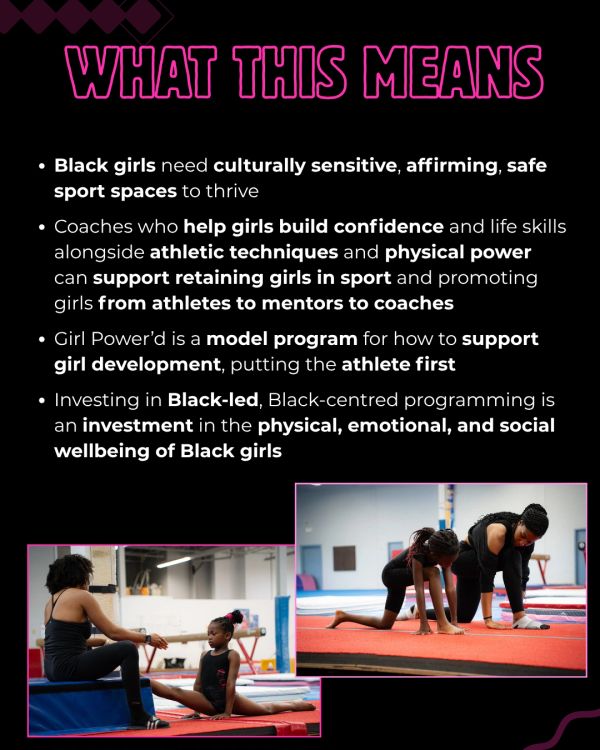
Black girls need culturally sensitive, affirming, safe sport spaces to thrive. Coaches who help girls build confidence and life skills alongside athletic techniques and physical power can support retaining girls in sport and promoting girls from athletes to mentors to coaches. Girl Power'd is a model program for how to support girl development, putting the athlete first. Investing in Black-led, Black-centred programming is an investment in the physical, emotional, and social wellbeing of Black girls.
Importantly, this confidence was not found alone. It was built in relationship. Each athlete described the importance of being with coaches and peers who looked like them. The program's confidence-building was also intergenerational: past athletes become coaches who affirmed the next cohort. Coaches were also explicit that this confidence was a life skill, actively teaching girls to take up space, speak up, and resist being made to feel small.
impact of our program

GP Research Results
Research has confirmed that participants do leave our program with increased confidence and self-awareness. Participants feel safe to express themselves and in turn achieve the goals they set out. 100% of participants achieve their goals in our programming.
Participate leave our program with:
- increased strength and flexibility
- new gymnastics skills
- increased rhythm and cultural dance movements
- increased body awareness
- a deeper understanding of their feelings
- how to verbally express themselves
- how to think critically
- healthier eating choices
- loving their Blackness deeper

Partnered research w/ Students COMMISSION of Canada
Results demonstrates that youth express very positive and enriching experiences in the Girl Power’d program. Girl Power’d offers young Black girls a safe space to connect, grow, and express themselves. The results illustrate that members feel empowered, self-confident, and strong. The safe space allows girls to express themselves through dance and movement, empowering them to use their voices and be their authentic selves. The program also acts as a therapeutic outlet for youth, allowing them to connect with themselves and be more mindful of their emotions.
Spaces like these are crucial for youth, as they foster self-growth, confidence, identity, and connection. It is evident that the program is enriching and empowering for young Black girls and bears many positive outcomes for their development. It is crucial for youth to be in a safe and positive environment where they can flourish and become their best selves.
Girl Power’d is continuing to meet their goal of building self-esteem and self-love within the Black community.

partnered research w/ mlse FOUNDATION
23 Self-identifying Black girls between the ages of 7 and 14 completed the Girl Power’d post-program survey. This program creates a safe space for Black girls to improve their gymnastics skills, develop confidence and increase their emotional intelligence. Each participant feels they have gotten physically stronger, more flexible and more skilled in gymnastics. 93% of participants feel more in tune with their emotions. 66% of the girls feel more comfortable about their bodies. Participants in the program scored strongly in Physical Literacy, which is an indicator of confidence in and motivation towards physical activity.
After completing this program, 94% of participants feel more capable of noticing their emotions. They have improved in distinguishing feelings of happiness, sadness, nervousness and joy within themselves. 67% of participants feel that they are more able to identify how those emotions affect their bodies.
When asked how comfortable they are in their body, 87% of the participants would rate their body a “seven” or above on a 10-point scale, which compares favourably to a recent British study where 66% of children feel negatively about their body image (Coffey, 2021). In Girl Power’d, 66% of participants indicated that they feel more comfortable about their bodies since joining the program. When asked if they would change anything about their bodies, 66% said no. Of those that said yes, there were three repeating attributes: Hair, weight and body shape.